Research Report
Entomological efficacy of lambdacyhalothrin treated nets in Anopheles gambiae pyrethroid resistance areas. The first village-scale comprehensive trial carried out in Northern Côte d’Ivoire. 
 ,
J. Chabi1 ,
G. Carnevale2 ,
P. Carnevale3
,
J. Chabi1 ,
G. Carnevale2 ,
P. Carnevale3 
2 Jalan Raya Sakah, Batuan, Sukawati; 80582, Bali, Indonesia
3 Le Majoral building Portiragnes France (Director of Pierre Richet Institute at the time of the study)
Author Correspondence author
Journal of Mosquito Research, 2026, Vol. 16, No. 4
Received: 24 Aug., 2026 Accepted: 18 Sep., 2026 Published: 29 Sep., 2026
The efficacy of lambdacyhalothrin-treated nets (« λITN”) on malaria transmission and disease was assessed, for the first time at villages level, in Anopheles gambiae pyrethroid resistance areas of N Côte d’Ivoire The base line data were obtained during a survey on rice cultivation, malaria transmission and morbidity, considering villages in three agroecosystems of Northern Côte d’Ivoire: (i) uncultivated lowlands “R0”, (ii) lowlands with one annual rice cultivation, in the rainy season, “R1” and (iii) developed lowlands with two annual rice cultivation cycles, “R2”. It appeared that the density of “main vectors”, mainly An. gambiae and An. funestus in R0; mainly An. gambiae in R1 and R2, increased with rice cultivation but the average yearly entomological inoculation rate (around 150 infective bites/human being) were almost similar.
The study on lambdacyhalothrin-treated mosquito nets (λITN) entomological and epidemiological efficacy was then carried out in this zone of An. gambiae high level of kdr resistance to deal with the burning issue of efficacy of treated nets when vectors are pyrethroid resistant.
From the list of villages surveyed during the study “rice cultivation and malaria” four paired villages (four villages of R2; two villages in R1 and two villages in R0) were selected and matched according to demographic, sociological, and ecological criteria. Among each pair, a village was randomly allocated to receive lambdacyhalothrin insecticide treated mosquito nets while the four other villages remained in their original state for one year, and considered as “control”, they received λITNs the following year.
The entomological impact of the treated nets was evaluated simultaneously with epidemiological studies in the same villages. Epidemiological information was already published showing that lambdacyhalothrin-treated nets induced a 56% reduction of malaria disease in children below 60-month-old. Up to now entomological data were not yet published as the first author passed after a long disease. We decided to publish the data in attrition to Dr Dossou-Yovo.
Entomological surveys were based on night capture on human being inside their houses. The main vectors were always An. gambiae in the three agroecosystems plus An. funestus in R0.
After implementation of λITN the “entomological inoculation rate” (EIR) due to An. gambiae decreased in the four villages receiving λITN, by an average of 90%; while in the villages without λITN the EIR naturally decreased by 47%; meaning a 48% gained efficacy with λITN implementation.
Adding data of the two main vectors showed that installation of λITN reduced the entomological inoculation rate two times more than what naturally occurred without such nets (relative reduction of 52.8%). This entomological level efficacy was remarkably similar the 56% reduction of the malaria incidence rate, a level comparable to the one observed almost everywhere with implementation of classical Long-lasting insecticide-treated nets in insecticide susceptible vectors areas.
1 Introduction
Since their first entomological evaluation in the experimental huts of Soumousso field station (Burkina Faso) (Darriet et al., 1984) then their first epidemiological evaluation in a savanna village of Burkina Faso showing a reduction of 50% of plasmodic index in protected children (Carnevale et al., 1988) and splenic index in Mali (Ranque et al., 1984), insecticide-treated nets (with pyrethroid) were tested in several countries, with different eco-epidemiological facies (Lengeler et al., 1996; Lengeler, 1998, 2000, 2004) showing a reduction of malaria transmission (by 80%) and malaria morbidity (by 50%).
Large-scale trial of insecticide treated nets in Kenya (Nevill et al., 1996), Ghana (Binka et al., 1996) and The Gambia (Alonso et al., 1993; D’Alessandro et al., 1995) showed they could reduce by 17% the overall infant mortality and could be “a new method of preventing malaria deaths” (Lengeler et al., 1996). Insecticide treated nets became the actual first new operational method of malaria vector control (Lengeler, 2004).
But the need for their regular retreatment, every 6-8 months hampered their sustainability in spite of the development of tablets such as deltamethrin (K-OTAB®) (Sharma et al., 2006) or ICON(®) Maxx 'dip-it-yourself' sachet kit for long-lasting treatment of polyester nets contains a slow-release capsule suspension of lambda-cyhalothrin plus binding agent (Tungu et al., 2015) make it easier the retreatment of nets.
Therefore were developed industrialized long-lasting insecticide-treated nets (“LLINs”) (Robert, 2020) such as initially Olyset Net® treated with permethrin (WHOPES, 2001) and PermaNet® 2.0 treated with deltamethrin (WHO, 2001).
Since then a lot of LLINs were developed, each one being treated with a pyrethroid (permethrin, deltamethrin, alpha-cypermethrin, lambdacyhalothrin) (WHO, 2020).
Large-scale distribution of LLINs since years 2000 induced a striking reduction of malaria morbidity and related malaria deaths and it was estimated that between 2000 and 2015 some 400 million of malaria cases and several hundred thousand deaths were averted in Africa thanks to the large scale distribution of insecticide-treated nets (Bhatt et al., 2015).
More than three billion of LLINs were already distributed and it is scheduled a regular distribution of three hundred million of LLINs with the ultimate goal of malaria elimination.
But the fast spreading of pyrethroid resistance is of great concern (Hemingway and Ranson, 2000; Hemingway et al., 2002; Ranson et al., 2011; Ranson and Lissende, 2016) and it is feared a malaria disaster as insecticide resistance would derail malaria control (Hemingway et al., 2016). It was recently reported that “Reduced efficacy of insecticide-treated nets and indoor residual spraying for malaria control in pyrethroid resistance area, Benin” (N’Guessan et al., 2007) but several co factors could intervene for the analysis pyrethroid resistance influence on the efficacy of LLINs (Kleinschmidt et al., 2018).
To overcome the issues of pyrethroid resistance several approaches were developed (WHO, 2020) such as bitreated nets with two insecticides (Guillet et al., 2001); or treated with a pyrethroid and chlorfenapyr (CPF) (Accrombessi et al., 2023; Zahouli et al., 2023; Sih et al., 2024), or piperonyl butoxide (PBO) (N’Guessan et al., 2010; Protopopoff et al., 2018), or pyriproxyfen (PPF) (9). (N’Gufor et al., 2014, 2015).
Malaria is still endemic in Côte d’Ivoire and the National Malaria Control Programme developed a comprehensive plan including case-management (based on Artemisin Combined Therapy drugs, Rapid Detection Tests etc) and vector control based on large-scale distribution of long-lasting insecticide treated nets.
But Anopheles gambiae pyrethroid resistance, observed in 1993 (Elissa et al., 1993) is now present all over the country (Chandre et al., 1999; Edi et al., 2012, 2014; Koffi et al., 2013; Camara et al., 2018).
“Three resistance mechanisms were identified, involving high allelic frequencies of kdr L1014F mutation (range = 0.46-1), relatively low frequencies of ace-1 R (below 0.5) and elevated activity of insecticide detoxifying enzymes, mainly mixed function oxidases (MFO), esterase and glutathione S-transferase (GST) in almost all study sites.” (Camara et al., 2018).
In the Korhogo Department “the frequency of the kdr allele in the An. gambiae s.s. population (frequency range: 90.70-100%) was very high” (Zogo et al., 2019) and “the ace-1 frequency in the An. gambiae s.s. population ranged from 15.18 to 30.05%” and they were observed in both An. gambiae and An. coluzzii with some variations and time and space (Camara et al., 2018).
A great lot of studies were devoted to this issue in insecticide resistance in Côte d’Ivoire (Koffi et al., 2012, 2013; Edi et al., 2012, 2014; Camara et al., 2018; Zogo et al., 2019; Kouassi et al., 2020; Meiwald et al., 2022; Kouamé et al., 2023; Lucas et al., 2023; N’Dri et al., 2023).
Most of them were done in experimental huts (Koffi et al., 2012, 2013, 2015; Oumbouke et al., 2019; Clegban et al., 2021) but entomological and epidemiological influence of LLINs at village-scale in area where An. gambiae is pyrethroid resistant remained to be done.
A comprehensive evaluation of the influence of rice cultivation on malaria transmission and morbidity in Korhogo area (“West Africa Rice Development in Africa WARDA project”) (Henry et al., 2003; Dossou-Yovo et al., 2024) procured reliable base line data for an implementation, and evaluation, of a vector control operation based of full coverage of communities with lambdacyhalothrin-treated mosquito nets against An. gambiae population with high level of kdr based insecticide resistance (Henry et al., 2005).
With the support from Zeneca® Company (for entomological studies), TDR-WHO (for parasitological and clinical studies) and IRAC (for genetical background studies of resistance) and with official clearance of national authorities a lambdacyhalothrin-treated mosquito nets programme was developed in eight villages of the previous 24 villages of the programme rice cultivation and malaria in Korhogo area.
This was the first comprehensive trial, at village-scale level, of lambdacyhalothrin-treated mosquito nets against pyrethroid resistant An. gambiae in Côte d’Ivoire.
New vector control operation in Korhogo area are scheduled starting with actualized data base collection (Zogo et al., 2019) to be compared to which one collected during this first trial and checked if a “long-trends in Anopheles gambiae insecticide resistance occurred in Korhogo area and whole Côte d’Ivoire.”(Edi et al., 2014)
2 Materials and Methods
The areas of the surveys were already presented (Henry et al., 2003; 2005; Dossou-Yovo et al., 2024).
The study was conducted in the Department of Korhogo, (between 9°10’ and 9°40’ N and between 5°20’ and 5°60’ W) northern Côte d’Ivoire.
“The Korhogo area is characterized by a Sudanese climate with a unimodal rainfall regimen from May to November. The annual rainfall varies from 1,200 to 1,400 mm, while the mean annual temperature ranges from 21 to 35 C. The minimum temperatures can drop to 16° C due to the Harmattan wind during December and January. The natural vegetation is mainly a mixture of savannah and open forest characterized by trees and shrubs that are approximately 8-15 m in height.” (Zogo et al., 2019).
2.1 Village’s studied
For the rice cultivation and malaria project 24 villages were classified according to the farming systems in their surrounding valleys within a two kms radius and were randomly selected: eight villages with no rice cultivation (called “R0”); eight villages with one cycle of rice cropping during the rainy season (called “R1”); and eight villages with water control that permits two cycles of rice cropping per year (called “R2”). The three categories of farming practice are referred as ‘‘agroecosystems’’ (Henry et al., 2003).
Eight villages were randomly selected and paired for receiving lambdacyhalothrin treated nets (λITN) the first year, the four other were considered as “control” and distribution of λITN was scheduled for these four villages the next year (Table 1a).
|
Table 1a Paired villages for the λITN first distribution. |
.png)
Before λITN implementation an in-depth census was made to precise the number of houses, inhabitants and every “sleeping-unit” in each of the eight villages randomly selected (Table 1b).
|
Table 1b Populations of the eight villages and sleeping units* (*=anything thing used for sleeping, mattress, cardboard, etc). |
.png)
All R1 and R2 villages were situated in the Department of Korhogo where all lowlands were cultivated.
The R0 village was situated in the Department of Katiola, where lowlands were not at all farmed.
2.2 Entomological evaluation
Entomological evaluation was done by night catches on human beings (“NC HB”) inside houses, in the same houses as for the “rice cultivation and malaria programme”. Night catches were done from 10 pm to 5 am, as it appeared, in analyzing previous data of the rice cultivation and malaria programme, that about 90% of transmission occurred during that period and the aim of λITNs programme was to check the influence of λITNs on malaria parasite transmission.
Mosquitoes were determined at species level; Anopheles ♀ were determined according to morphological criteria and classical keys, (Gillies and De Meillon, 1968) then with biological method (Touré et al., 2012).
For the λITN evaluation, An. gambiae and An. funestus only (as they previously appeared to be the main vectors) were dissected (ovaries, salivary glands) in the field at the time of collection.
2.3 λITN implementation
Impregnations of mosquito nets were done directly in the villages with local health workers. Mosquito nets were allocated for each sleeping unit and received a double code, with the name of the village and the Number of house and «bed» with both a permanent marker and a water soluble one to check any wash.
The first impregnation was done in Nambekaha village with regional authorities and representative of national authorities (National Malaria Control Programme). 1,958 Mosquito nets (gift from Zeneca®, ordered in SiamDutch® Co) were treated with lambdacyhalothrin (“λ”) presented as ICON® CS 2.5, at the targeting dosage of 15 mg a.i./m2 and distributed to populations. This operation lasted 10 days.
The other villages received λITNs treated with the same protocol.
After the first installation of λITNs four entomological surveys were done.
As scheduled, retreatment was done six months later, with same treatment and insecticide (still to get 15 mg a.i./m2).
After retreatment of λITNs, four more surveys were done.
The amount of insecticide used for treatment and retreatment and coverage are presented in the Table 2.
|
Table 2 Insecticide treatments of nets. |
.png)
The entomological inoculation rate was calculated with Ross’ formula h= ma.s where ma=landing rate per human being per night and s= sporozoite index.
For first treatment 20.6 l were used to treat 1,958 mosquito nets; for the retreatment, 16.7 l were used to treat 1,604 mosquito nets i.e. a total of 37.2 liters to treat 3,562 nets meaning an overall average concentration of 17.4 mg a.i./m2 for a target dosage of 15 mg a.i./m2.
According to the surface of one net (# 15 m2) 29,370 m2 were treated the first time then 24,060 m2 the next one.
According to the amount of insecticide used the expected average dosage of impregnation was 17.5 mg a.i./m2 the first time then 17.4 mg a.i./m2 for the redipping.
Treatment was done by «mass dipping» by lots of ten mosquito nets, the initial solution being composed of 49 l. of water and one liter of Icon® CS 2.5. After dipping mosquito nets dried in shadow places in the villages and were distributed to populations according to the census.
3 Results
3.1 Nets coverage
A check done three months after the second treatment of nets showed that 80% of the population were still protected which is the level requested to obtain a community protection moreover the personal protection (Table 3) and nets were still in good condition.
|
Table 3 Treatments of nets and coverage. |
.png)
3.2 Entomological data
Before implementation of λITNs eight entomological surveys were done in the eight villages representing 72 men/nights/villages i.e. a total of 576 men/night.
During λITNs experimentation eight surveys were done, «matched» in time with the previous one, representing 48 men/night/village i.e. 384 men/night.
A total of 31,276 mosquitoes were collected when landing on human beings inside houses (Table 4), 22,931 the first year considered as data base collection, and 8,345 the year of the trial.
-1,901 mosquitoes were collected in the two villages of lowlands without rice cultivation («R0»);
-3,520 mosquitoes were collected in the two villages of lowlands with rainy rice, one crop/year (“R1”);
-25,855 mosquitoes were collected in the four villages of lowlands with irrigated rice, two crops/year (“R2”).
|
Table 4 Mosquitoes collected while landing on human beings inside houses (Year 1= base line data, “B” for before; Year 2= vector control, after vector control, “A” for after). |
.png)
The mosquitoes sample was composed of 5 genera and 28 species (Annex).
In the four villages where λITN were implemented 14,144 mosquitoes were caught before vector control i.e. an average human landing rate of 24.6 bites/Human Being/Night and 3,315 the year with λITN i.e. an average biting rate of 8.6 bites/Human Being/Night i.e. a 64.8% reduction.
In the four “control villages 8,784 mosquitoes were caught the first year i.e. 15.3 bites/Human Being/Night and 5,030 i.e. 13.1 bites/Human Being/Night the second year i.e. almost the same landing rate.
3.2.1 Entomological data dealing with Anopheles gambiae
Biological analysis showed that the An. gambiae s.l. sample was mainly composed of An. gambiae (97%) and few An. coluzzii (3%) (Touré et al., 2012); therefore further analysis gathered the two species and quoted as An. gambiae.
3.2.1.1 Evolution of the landing rate
Before vector control 11,351 specimen of An. gambiae were caught when landing on human being (HB) inside houses during the night (N) meaning a human landing rate of 39.4 bites/Human Being/Night; while the second year 2,393 specimen were caught meaning a landing rate of 12.5 bites/Human Being/Night i.e. a decrease of 68.3% (Table 5a).
|
Table 5a Evolution of the landing rate (ma) of An. gambiae inside human houses after implementation of lambdacyhalothrin treated ITNs (Before= 72 “men night”/village i.e. a total of 288 “men night” collection; After= 48 “men night”/villages i.e. a total of 192 “men night”; Diff= difference; Agrosyst= agrosystem). |
.png)
After implementation of lambdacyhalothrin treated nets the agressivity of An. gambiae remained similar in two villages and decreased by # 50% in two villages (Table 5b).
|
Table 5b Evolution of the landing rate (ma) of An. gambiae inside human houses without implementation of lambdacyhalothrin treated mosquito nets (Before= 72 “men night”/village i.e. a total of 288 “men night collection”; after= 48 “men night”/villages i.e. a total of 192 men night collection). |
.png)
In the four villages with λITNs the landing rate was 37.8% lower than in villages which remained without λITNs.
3.2.1.2 Evolution of the infectivity
Sporozoites were detected in 189 of the whole sample of 11,634 salivary glands dissected (overall sporozoite index s.i.=1.62%). Before λITNs implementation sporozoites were detected in 162 of the 8,928 salivary glands dissected (s.i.=1.81%) while the following year sporozoites were observed in 27 of the 2,706 salivary glands dissected (s.i..= 0.99%).
After λITNs implementation in the four villages the sporozoite index of An. gambiae significantly decreased from 1.95% (n=5,854) to 0.64% (n=1,397) (Table 6a) (χ2=12.88; p=0.0003; OR=0.29 [0.14-0.59]).
|
Table 6a Evolution of sporozoite index in the four villages where λITNs were implemented (D= number of salivary glands dissected; SG+= salivary glands with sporozoites; si= sporozoite index). |

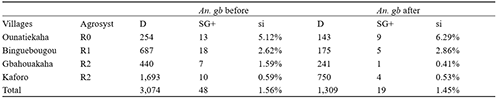
In the four villages which remained without λITNs the sporozoite index of An. gambiae remained similar: 1.56% (n=3,074) and 1.45% (n=1,309) (Table 6b) (χ2= 0.0738; p= 0.78; OR= 0.93 [0.54-1.58]).
|
Table 6b Evolution of sporozoite index in the four villages without λITNs (“control villages”) (D= number of salivary glands dissected; SG+= salivary glands with sporozoites; si= sporozoite index). |
3.2.1.3 Evolution of the entomological inoculation rate
The evolution of the entomological inoculation rate (EIR) according to year, and implementation of λITNs, or not, was estimated in combining Table 5a and 5b (landing rate) and 6a and 6b (sporozoite index) for each village (Table 7a, Table 7b).
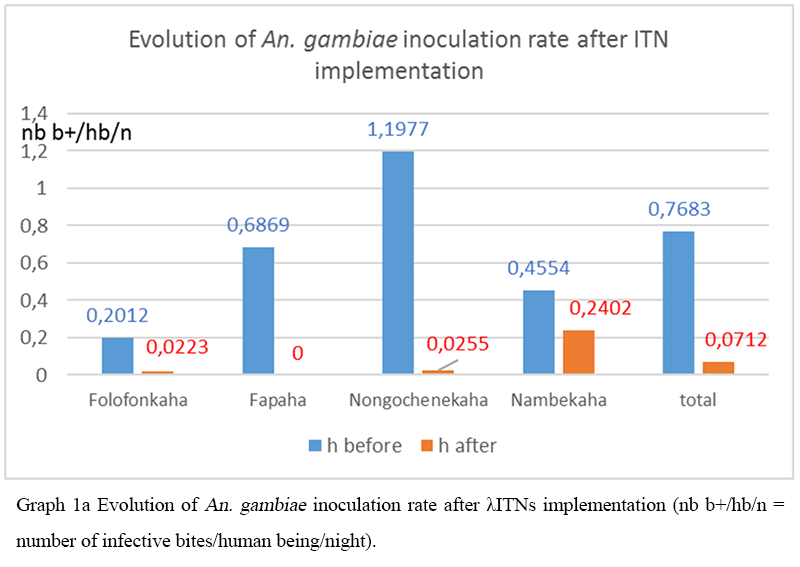
After the implementation of λITNs the entomological inoculation rate sharply decreased in each village (Graph 1a); by an average of 90.7%, (Table 7a) except in Nambekaha (R2 agroecosystem) where the inoculation decreased but with a value similar as in villages without λITNs.
|
Table 7a Evolution of the An. gambiae inoculation rate (h) with λITNs implementation (ITN-+) (B=>A: difference between h before (“B”) and after (“A”) λITNs implementation). |

|
Table 7b Evolution of the An. gambiae inoculation rate (h) without λITNs implementation (ITN--) (B=>A: difference between h before, (=year 1) (“B”) and after (“A”) (=year 2). |

|
Graph 1a Evolution of An. gambiae inoculation rate after λITNs implementation (nb b+/hb/n = number of infective bites/human being/night). |
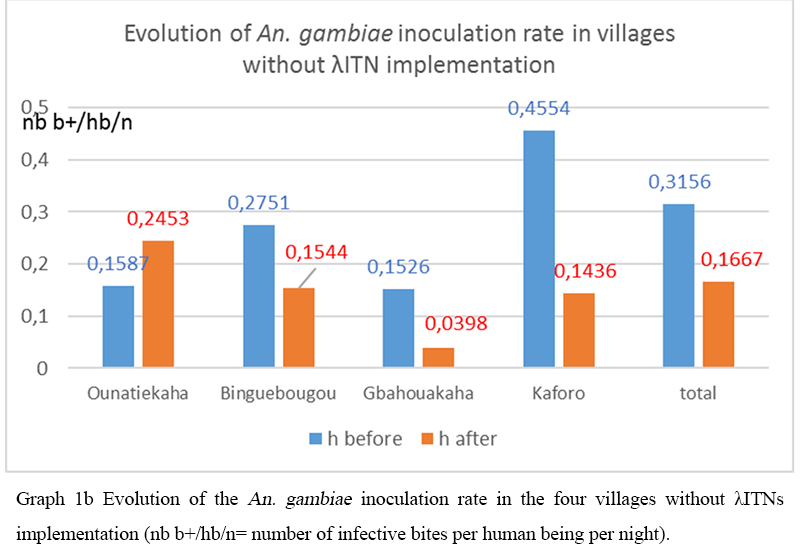
In villages which remained without treated nets (Table 7b) the inoculation rate decreased in each village (Graph 1b); with an average of 46.8% and almost the same values except in one village (Gbahouakaha) where the decrease reached 74%.
|
Graph 1b Evolution of the An. gambiae inoculation rate in the four villages without λITNs implementation (nb b+/hb/n= number of infective bites per human being per night). |
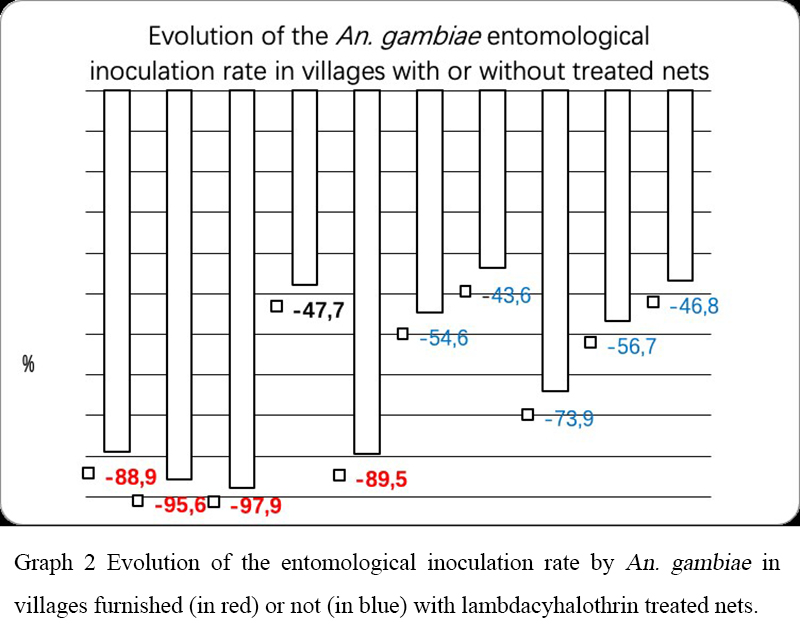
The entomological inoculation rate of An. gambiae decreased in the eight villages but two times mores in villages furnished with lambdacyhalothrin treated nets than in villags without these nets (Graph 2).
|
Graph 2 Evolution of the entomological inoculation rate by An. gambiae in villages furnished (in red) or not (in blue) with lambdacyhalothrin treated nets. |
3.2.2 Entomological data dealing with Anopheles funestus
3.2.2.1 Evolution of landing rate
During the two years of the trial 1,082 ♀ An. funestus were collected (Table 8a and 8b); 671 ♀ the first year and 411 ♀ the second year.
|
Table 8a Evolution of the landing rate of An. funestus in the villages after λITNs implementation ITN-+ (VC = vector control; diff = difference between before and after; C= number of specimens caught). |

|
Table 8b Evolution of the landing rate of An. funestus in the villages without λITNs implementation (ITN--) (VC = vector control; diff = difference between before and after; C= number of specimens caught). |

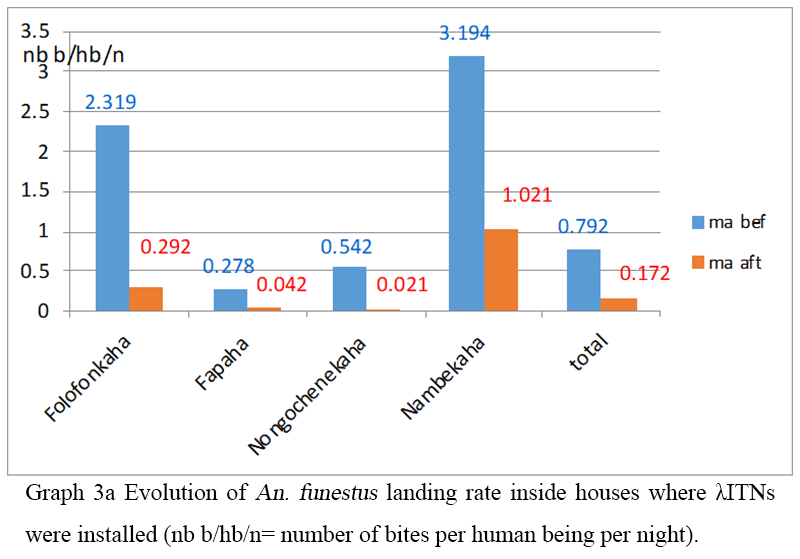
After implementation of λITNs the landing rate decreased in each village (Graph 3a) with an average of 78.3%.
|
Graph 3a Evolution of An. funestus landing rate inside houses where λITNs were installed (nb b/hb/n= number of bites per human being per night). |
In villages without λITNs installation the landing rate decreased in three villages (Table 8b) but it greatly increased in one, Ounatiekaha (Graph 3b).
|
Graph 3b Evolution of An. funestus landing rate inside houses of villages without λITNs. (nb b/hb/n= number of bites per human being per night). |
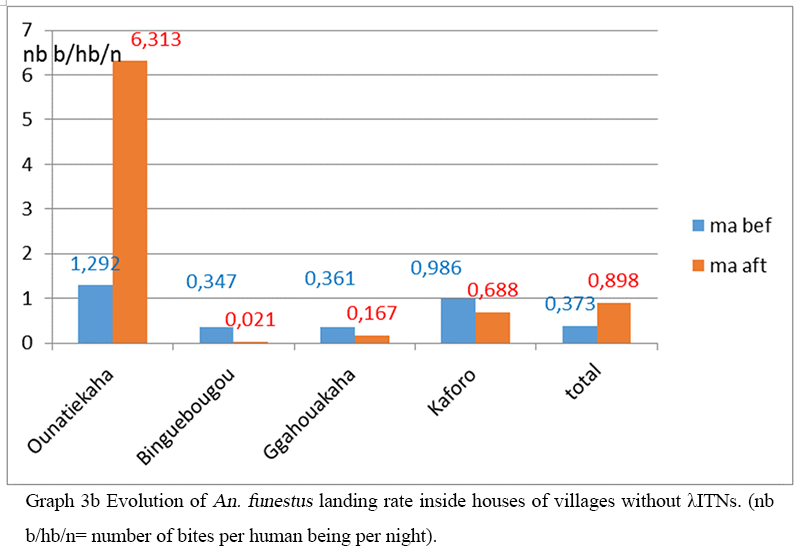
Gathering data from the four villages without λITNs the landing rate increased by two times.
3.2.2.2 Evolution of the infectivity
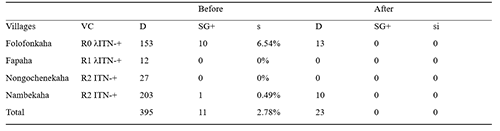
In the four villages before λITNs implementation sporozoites were detected in 11 of the 395 salivary glands dissected (s.i.= 2.78%) while not a single salivary gland was found with sporozoites among the 23 specimens dissected (Table 9a) meaning that sporozoite index became lower than the detectability threshold of the method used.
|
Table 9a Infectivity of An. funestus dissected in villages where λITNs were installed (D= number of specimens dissected; SG+= number of salivary glands with sporozoites); VC= vector control) (λITN-+ = installation λITNs). |
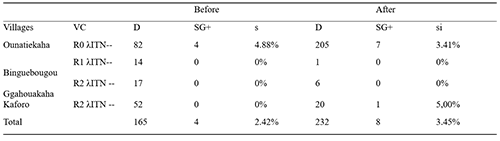
In villages without λITNs installation the sporozoites remained at the same value (Table 9b), respectively s.i. = 2.42% (n=165) the first year and s.i.= 3.45% (n=232) the second year (χ2= 0.345; p= 0.557; OR= 0.69 [0.21-2.35]).
|
Table 9b Infectivity of An. funestus dissected in villages without λITNs (D= number of specimens dissected; SG+= number of salivary glands with sporozoites; VC= vector control) (λITN-- = no λITNs installed). |
3.2.2.3 Evolution of the inoculation rate
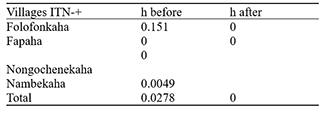
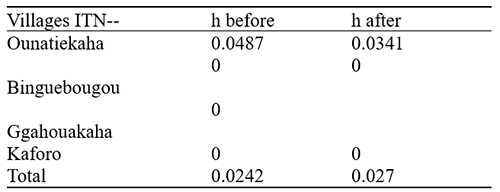
Combining the agressivity (Table 8a, Table 8b) and infectivity (Table 9a, Table 9b) it is possible to estimate the evolution, from year to year, of the daily entomological inoculation rate in villages furnished in λITNs (Table 10a) and villages which remained without λITNs installation (Table 10b).
|
Table 10a Evolution of the An. funestus inoculation rate (h) before vs after λITNs implementation. |
|
Table 10b Evolution of the An. funestus inoculation rate (h) in villages without λITNs implementation. |
Two points clearly appeared:
-The first year, when villages were “as they were”, the overall daily entomological inoculation rates were similar; respectively: 0.0278 infected bite/human being/night in villages “targeted for λITNs” and 0.0242 in villages “targeted for control.”
-The second year, after implementation of λITN, the sporozoites index in the four villages furnished became so low that it was not possible to estimate the inoculation rate while in villages which remained without λITNs the inoculation rate remained at the same value as the previous year (respectively 0.0242 and 0.0270 infected bites/human being/night).
3.2.3 Overall evolution of the entomological inoculation rate
Adding the inoculation rate by An. gambiae and An. funestus procure a proxy of the overall inoculation rate due to these main vectors in villages before and after implementation of λITNs or not (Table 11a, Table 11b).
After λITN implementation the daily inoculation rate decreased by 91% (Table 11a).
|
Table 11a Evolution of the inoculation rate (h) due to both An. gambiae and An. funestus after implementation of λITNs (h gb bef= h by An. gambiae before λITNs implementation; h gb aft= h by An. gambiae after λITNs implementation; h fu bef= h by An. funestus before λITNs implementation; h fu aft= h by An. funestus after λITNs implementation; h total = sum h by An. gambiae and An. funestus before and after; diff = difference of inoculation rate before vs after λITNs implementation). |

|
Table 11b Evolution of the inoculation rate (h) due to both An. gambiae and An. funestus in villages which remained without λITNs implementation (λITN- = initial situation; ITN-- = no installation of λITNs; gb= Anopheles gambiae; fu= Anopheles funestus; diff= difference between year 1 and year 2). |

In villages where λITNs where not installed the inoculation rate decreased by 43% on the average, (Table 11b) at different level according to villages or even increased from year to year (R0).
This means that installation of λITNs reduced the inoculation rate two times more than what naturally occurred without such nets (relative reduction of 52.8%).
4 Discussion
A great lot of trials were devoted to lambdacyhalothrin treated mosquito nets (Das et al., 1993; Somboon et al., 1995; Jawara et al., 1998; Marbiah et al., 1998; Buttaporn et al., 1999; Kamolratanakul et al., 2001; Asidi et al., 2005; Vatandoost et al., 2006; Sahu et al., 2008) alone, or in combination, against insecticide-resistant Anopheles gambiae.
Insecticide resistance is one of the main issue to get efficient vector control and new approaches are needed for “averting a malaria disaster”(Hemingway et al., 2016).
In Côte d’Ivoire pyrethroid resistance is present all over the country (Chandre et al., 1999; Koffi et al., 2013; Zoh et al., 2018) and several tests were undertaken to evaluate new models of LLINs (Oumbouke et al., 2019); in experimental huts of field station where An. gambiae populations are resistant with different mechanisms (Koffi et al., 2012, 2013, 2015).
In An. gambiae populations of Northern Côte d’Ivoire (Touré et al., 2012) “the frequencies of the resistant allele at kdr mutation L1014F locus were very high and varied from 0.82 to 0.96. Before the trial, the genotype frequencies of specimens at kdr locus did not show any difference. However, they significantly increased in mosquitoes from treated villages (0.94) compared to those from control villages (0.87) on month 14 (P= 0.13). In contrary, a significant differences was observed before and after the trial between mosquitoes from villages with two cycles of rice cultivation per year and those from villages without rice cultivation (P= 0.008 and P= 0.012). Nine out of twelve populations of field mosquitoes showed Hardy-Weinberg disequilibrium at kdr locus (P<0.05). The S and M molecular forms of An. gambiae (= An. gambiae s.s. and An. coluzzii respectively) were sympatric in Korhogo area and the S form (An. gambiae s.s.) represents 97%. No hybrid was observed. All individuals of the M form (= An. coluzzii) were susceptible at kdr locus.”
Trials done in experimental huts in Côte d’Ivoire (in WHOPES phase II protocol) and Bénin clearly showed that pyrethroid resistance could reduce the efficacy of classical Long-Lasting Insecticide treated Nets (Kolaczinsky et al., 2000; N’Guessan et al., 2007).
But even in such situations permethrin or deltamethrin or lambdacyhalothrin treated mosquito nets could still procure some protection (Henry et al., 1999).
Actually, a first trial, in Kafine village (Côte d’Ivoire), with permethrin treated nets (Olyset® Nets) (Doanio et al., 1999) where local Anopheles gambiae population is highly resistant to pyrethroid with kdr allelic frequency> 90%, it was observed an interesting reduction of incidence of malaria morbidity (Henry et al., 1999) even if no entomological impact was noticed (Doanio et al., loc.cit.) showing that these treated nets procured an actual personal protection against the main vector (Henry et al., loc.cit.).
With these information it was decided to test the eventual influence of lambdacyhalothrin-treated mosquito nets at larger scale in villages of Korhogo area where previous entomological and epidemiological studies were done to precise the eventual influence of rice cultivation on malaria transmission and morbidity (Henry et al., 2003; Dossou-Yovo et al., 2024) and where local Anopheles gambiae population is pyrethroid resistant (likely due to large-scale use of insecticide on cotton culture) and the average kdr allelic frequencies are # 80%. (Chandre et al., 1999; Touré et al., 2012).
After one year of getting base-line data, during the programme “rice cultivation and malaria” (Henry et al., 2003; Dossou-Yovo et al., 2024) some 2,000 lambdacyhalothrin treated mosquito nets were distributed in four villages (3,500 people) in two steps, first impregnation then redipping six months latter while four paired villages of similar agroecosystems remained without such vector control.
Comprehensive evaluation was undertaken, with simultaneous entomological and epidemiological surveys, to get a double evaluation: before/after and here/there.
Entomological data were obtained by classical night catches of mosquitoes when landing of human beings and epidemiological studies were done exactly as for the rice cultivation and malaria surveys.
Two key points must be kept in mind and are of paramount importance for the vector control approach in malaria control programme.
Even in An. gambiae with high level of kdr based pyrethroid resistance, lambdacyhalothrin-treated mosquito nets conferred an actual reduction of biting rate, infectivity, and inoculation rates which was decreased by 90% while in control villages the inoculation rate decreased by 43% meaning a 53% more reduction obtained by treated nets than natural variations.
The concomitant similar reduction of incidence rate of malaria crisis among children (Henry et al., 2005) showed that lambdacyhalothrin-treated mosquito nets could actually confer efficient both personal protection and collective prevention even if vectors are insecticide resistant.
Actually “clinical malaria observed by active case detection reported that; in the treated villages, the incidence was significantly lower than in the control villages: 0.8 versus 1.8 clinical malaria attacks per child per year (P < 0.001). The protective clinical efficacy of treated nets was 56% (95% CI, 25-75%).” (60)(Henry et al. loc.cit.) This figure of 56% of malaria morbidity is to be compared to the 53% reduction of the entomological inoculation rate obtained after introduction of lambdacyhalothrin treated nets.
These results demonstrate the interest of integrated multidisciplinary field surveys and the correspondence between reduction of transmission and malaria morbidity.
Thanks
The trial of treated nets received support from Zeneca® Company, WHO-WHOPES, WHO-TDR and IRAC.
We thank the Ministry of Health and the National Malaria Control Programme for their agreement and support.
We would also like to thank the village chiefs and the local population for their hospitality and participation in these field studies.
Authors
J. Dossou-Yovo was involved in the protocol, field surveys, first analysis of data and first report.
J. Chabi was involved in field surveys.
G. Carnevale was involved in writing and English editing.
P. Carnevale, was involved in preparing the protocol, monitoring field surveys, statistical analyses of data and writing the document.
Conflict of Interest
Authors declared they have no conflict of interest.
No AI used.
Accrombessi M., Cook J., Dangbenon E., Yovogan B., Akpovi H., Sovi A., Adoha C., Assongba L., Sidick A., Akinro B., Ossè R., Tokponnon F., Aïkpon R., Ogouyemi-Hounto A., Padonou G.G., Kleinschmidt I., Messenger L.A., Rowland M., Ngufor C., Protopopoff N., and Akogbeto M.C., 2023, Efficacy of pyriproxyfen-pyrethroid long-lasting insecticidal nets (LLINs) and chlorfenapyr-pyrethroid LLINs compared with pyrethroid-only LLINs for malaria control in Benin: a cluster-randomised, superiority trial, The Lancet, 401(10375): 435-446.
https://doi.org/10.1016/S0140-6736(22)02319-4
Alonso P.L., Lindsay S.W., Schellenberg J.R.M.A., Keita K., Gomez P., Shenton F.C., Hill A.G., David P.H., Fegan G., Cham K., and Greenwood B.M., 1993, A malaria control trial using insecticide-treated bed nets and targeted chemoprophylaxis in a rural area of The Gambia, west Africa. 6. The impact of the interventions on mortality and morbidity from malaria, Transactions of the Royal Society of Tropical Medicine and Hygiene, 87: 37-44.
https://doi.org/10.1016/0035-9203(93)90174-O
Asidi A.N., N'Guessan R., Koffi A.A., Curtis C.F., Hougard J.M., Chandre F., Corbel V., Darriet F., Zaim M., and Rowland M.W., 2005, Experimental hut evaluation of bednets treated with an organophosphate (chlorpyrifos-methyl) or a pyrethroid (lambdacyhalothrin) alone and in combination against insecticide-resistant Anopheles gambiae and Culex quinquefasciatus mosquitoes, Malaria Journal, 4(1): 25.
https://doi.org/10.1186/1475-2875-4-25
Bhatt S., Weiss D.J., Cameron E., Bisanzio D., Mappin B., Dalrymple U., Battle K.E., Moyes C.L., Henry A., Eckhoff P.A., Wenger E.A., Briët O., Penny M.A., Smith T.A., Bennett A., Yukich J., Eisele T.P., Griffin J.T., Fergus C.A., Lynch M., Lindgren F., Cohen J.M., Murray C.L.J., Smith D.L., Hay S.I., Cibulskis R.E., and Gething P.W., 2015, The effect of malaria control on Plasmodium falciparum in Africa between 2000 and 2015, Nature, 526(7572): 207-211.
https://doi.org/10.1038/nature15535
Binka F.N., Kubaje A., Adjuik M., Williams L.A., Lengeler C., Maude G.H., Armah G.E., Kajihara B., Adiamah J.H., and Smith P.G., 1996, Impact of permethrin impregnated bednets on child mortality in Kassena-Nankana district, Ghana: a randomized controlled trial, Tropical Medicine & International Health, 1(2): 147-154.
https://doi.org/10.1111/j.1365-3156.1996.tb00020.x
Butraporn P., Kamolratanakul P., Prasittisuk M., Prasittisuk C., and Indaratna K., 1999, Cost-effectiveness analysis of lambdacyhalothrin-treated nets for malaria control: the patients' perspective, Southeast Asian Journal of Tropical Medicine and Public Health, 30(3): 427-431.
Camara S., Koffi A.A., Ahoua Alou L.P., Koffi K., Kabran J.P.K., Koné A., Koffi M.F., N'Guessan R., and Pennetier C., 2018, Mapping insecticide resistance in Anopheles gambiae (s.l.) from Côte d'Ivoire, Parasites & Vectors, 11(1): 19.
https://doi.org/10.1186/s13071-017-2546-1
Carnevale P., Robert V., Boudin C., Halna J.M., Pazart L., Gazin P., Richard A., and Mouchet J., 1988, La lutte contre le paludisme par des moustiquaires imprégnées de pyréthrinoïdes au Burkina Faso, Bulletin de la Société de Pathologie Exotique, 81(5): 832-846.
Chandre F., Darriet F., Manguin S., Brengues C., Carnevale P., and Guillet P., 1999, Pyrethroid cross resistance spectrum among populations of Anopheles gambiae s.s. from Côte d'Ivoire, Journal of the American Mosquito Control Association, 15(1): 53-59.
Chandre F., Darriet F., Manga L., Akogbeto M., Faye O., Mouchet J., and Guillet P., 1999, Status of pyrethroid resistance in Anopheles gambiae sensu lato, Bulletin of the World Health Organization, 77(3): 230.
Chandre F., Manguin S., Brengues C., Dossou Yovo J., Darriet F., Diabate A., Carnevale P., and Guillet P., 1999, Current distribution of a pyrethroid resistance gene (kdr) in Anopheles gambiae complex from west Africa and further evidence for reproductive isolation of the Mopti form, Parassitologia, 1991: 319-322.
Clegban C.-M.Y., Camara S., Koffi A.A., Ahoua Alou L.P., Kabran Kouame J.-P., Koffi A.F., Kouassi P.K., Moiroux N., and Pennetier C., 2021, Evaluation of Yahe® and Panda® 2.0 long-lasting insecticidal nets against wild pyrethroid-resistant Anopheles gambiae s.l. from Côte d'Ivoire: an experimental hut trial, Parasites & Vectors, 14(1): 347.
https://doi.org/10.1186/s13071-021-04843-x
D'Alessandro U., Olaleye B.O., McGuire W., Langerock P., Bennett S., Aikins M.K., Thomson M.C., Cham M.K., Cham B.A., and Greenwood B.M., 1995, Mortality and morbidity from malaria in Gambian children after introduction of an impregnated bednet programme, The Lancet, 345(8948): 479-483.
https://doi.org/10.1016/S0140-6736(95)90582-0
Darriet F., Robert V., Tho Vien N., and Carnevale P., 1984, Evaluation de l'efficacité sur les vecteurs du paludisme de la perméthrine en imprégnation sur des moustiquaires intactes et trouées. No. WHO/MAL/84.1008. Organisation mondiale de la Santé, pp.20.
Das P.K., Das L.K., Parida S.K., Patra K.P., and Jambulingam P., 1993, Lambdacyhalothrin treated bed nets as an alternative method of malaria control in tribal villages of Koraput District, Orissa State, India, Southeast Asian Journal of Tropical Medicine and Public Health, 24(3): 513-521.
Doannio J.M.C., Dossou-Yovo J., Diarrassouba S., Chauvancy G., Darriet F., Chandre F., Henry M.C., Nzeyimana I., Guillet P., and Carnevale P., 1999, Efficacité des moustiquaires pré-imprégnées de perméthrine Olyset Net® en zone de résistance des vecteurs aux pyréthrinoïdes: 1. Evaluation entomologique, Médecine Tropicale, 59(4): 349-354.
Dossou-Yovo J., Chabi J., Carnevale G., and Carnevale P., 2024, Rice cultivation and malaria transmission in the korhogo region (n. Côte d'Ivoire), RPC Journal of Medical Sciences, 1(1): 6-15.
Edi C.V.A., Koudou B.G., Jones C.M., Weetman D., and Ranson H., 2012, Multiple-insecticide resistance in Anopheles gambiae mosquitoes, Southern Côte d'Ivoire, Emerging Infectious Diseases, 18(9): 1508.
https://doi.org/10.3201/eid1809.120262
Edi C.A.V., Koudou B.G., Bellai L., Adja A.M., Chouaibou M., Bonfoh B., Barry S.J.E., Johnson P.C.D., Müller P., Dongus S., N'Goran E.K., Ranson H., and Weetman D., 2014, Long-term trends in Anopheles gambiae insecticide resistance in Côte d'Ivoire, Parasites & Vectors, 7(1): 500.
https://doi.org/10.1186/PREACCEPT-2061731242135355
Elissa N., Mouchet J., Riviere F., Meunier J.Y., and Yao K., 1993, Resistance of Anopheles gambiae s.s. to pyrethroids in Côte d'Ivoire, Annales de la Société Belge de Médecine Tropicale, 73(4): 291-294.
Gillies M.T., and De Meillon B., 1968, The anophelinae of Africa South of the Sahara: Ethiopian Zoogeographical Region, South African Institute for Medical Research, 54: 343.
Guillet P., N'Guessan R., Darriet F., Traore-Lamizana M., Chandre F., and Carnevale P., 2001, Combined pyrethroid and carbamate 'two-in-one' treated mosquito nets: field efficacy against pyrethroid-resistant Anopheles gambiae and Culex quinquefasciatus, Medical and Veterinary Entomology, 15(1): 105-112.
https://doi.org/10.1046/j.1365-2915.2001.00288.x
Hemingway J., and Ranson H., 2000, Insecticide resistance in insect vectors of human disease, Annual Review of Entomology, 45(1): 371-391.
https://doi.org/10.1146/annurev.ento.45.1.371
Hemingway J., Field L., and Vontas J., 2002, An overview of insecticide resistance, Science, 298(5591): 96-97.
https://doi.org/10.1126/science.1078052
Hemingway J., Ranson H., Magill A., Kolaczinski J., Fornadel C., Gimnig J., Coetzee M., Simard F., Dabiré K.R., Hinzoumbe C.K., Pickett J., Schellenberg D., Gething P., Hoppé M., and Hamon N., 2016, Averting a malaria disaster: will insecticide resistance derail malaria control?, The Lancet, 387(10029): 1785-1788.
https://doi.org/10.1016/S0140-6736(15)00417-1
Henry M.C., Rogier C., Nzeyimana I., Assi S.B., Dossou-Yovo J., Audibert M., Mathonnat J., Keundjian A., Akodo E., Teuscher T., and Carnevale P., 2003, Inland valley rice production systems and malaria infection and disease in the savannah of Côte d'Ivoire, Tropical Medicine & International Health, 8(5): 449-458.
https://doi.org/10.1046/j.1365-3156.2003.01053.x
Henry M.C., Assi S.B., Rogier C., Dossou-Yovo J., Chandre F., Guillet P., and Carnevale P., 2005, Protective efficacy of lambda-cyhalothrin treated nets in Anopheles gambiae pyrethroid resistance areas of Côte d'Ivoire, American Journal of Tropical Medicine and Hygiene, 73(5): 859-864.
https://doi.org/10.4269/ajtmh.2005.73.859
Henry M.-C., Doannio J.M.C., Darriet F., Nzeyimana I., and Carnevale P., 1999, Efficacité des moustiquaires pré-imprégnées de perméthrine Olyset Net en zone de résistance des vecteurs aux pyréthrinoïdes. II. Evaluation parasitoclinique, Médecine Tropicale, 59(4): 355-357.
Jawara M., McBeath J., Lines J.D., Pinder M., Sanyang F., and Greenwood B.M., 1998, Comparison of bednets treated with alphacypermethrin, permethrin or lambdacyhalothrin against Anopheles gambiae in the Gambia, Medical and Veterinary Entomology, 12(1): 60-66.
https://doi.org/10.1046/j.1365-2915.1998.00083.x
Kamolratanakul P., Butraporn P., Prasittisuk M., Prasittisuk C., and Indaratna K., 2001, Cost-effectiveness and sustainability of lambdacyhalothrin-treated mosquito nets in comparison to DDT spraying for malaria control in western Thailand, American Journal of Tropical Medicine and Hygiene, 65(4): 279-284.
https://doi.org/10.4269/ajtmh.2001.65.279
Kleinschmidt I., Bradley J., Knox T.B., Mnzava A.P., Kafy H.T., Mbogo C., Ismail B.A., Bigoga J.D., Adechoubou A., Raghavendra K., Cook J., Malik E.M., Nkuni Z.J., Macdonald M., Bayoh N., Ochomo E., Fondjo E., Awono-Ambene H.P., Etang J., Akogbeto M., Bhatt R.M., Chourasia M.K., Swain D.K., Kinyari T., Subramaniam K., Massougbodji A., Okê-Sopoh M., Ogouyemi-Hounto A., Kouambeng C., Abdin M.S., West P., Elmardi K., Cornelie S., Corbel V., Valecha N., Mathenge E., Kamau L., Lines J., and Donnelly M.J., 2018, Implications of insecticide resistance for malaria vector control with long-lasting insecticidal nets: a WHO-coordinated, prospective, international, observational cohort study, The Lancet Infectious Diseases, 18(6): 640-649.
https://doi.org/10.1016/S1473-3099(18)30172-5
Koffi A.A., Ahoua Alou L.P., Kabran J.-P.K., N'Guessan R., and Pennetier C., 2013, Re-visiting insecticide resistance status in Anopheles gambiae from Côte d'Ivoire: a nation-wide informative survey, PLoS ONE, 8(12): e82387.
https://doi.org/10.1371/journal.pone.0082387
Koffi A.A., Ahoua Alou L.P., Adja M.A., Koné M., Chandre F., and N'Guessan R., 2012, Update on resistance status of Anopheles gambiae s.s. to conventional insecticides at a previous WHOPES field site, "Yaokoffikro", 6 years after the political crisis in Côte d'Ivoire, Parasites & Vectors, 5(1): 68.
https://doi.org/10.1186/1756-3305-5-68
Koffi A.A., Ahoua Alou L.P., Djenontin A., Kabran J.-P.K., Dosso Y., Kone A., Moiroux N., and Pennetier C., 2015, Efficacy of Olyset® Duo, a permethrin and pyriproxyfen mixture net against wild pyrethroid-resistant Anopheles gambiae s.s. from Côte d'Ivoire: an experimental hut trial, Parasite, 22: 28.
https://doi.org/10.1051/parasite/2015028
Koffi A.A., Ahoua Alou L.P., Adja M.A., Chandre F., and Pennetier C., 2013, Insecticide resistance status of Anopheles gambiae s.s. population from M'Bé: a WHOPES-labelled experimental hut station, 10 years after the political crisis in Côte d'Ivoire, Malaria Journal, 12(1): 151.
https://doi.org/10.1186/1475-2875-12-151
Kolaczinski J.H., Fanello C., Hervé J.-P., Conway D.J., Carnevale P., and Curtis C.F., 2000, Experimental and molecular genetic analysis of the impact of pyrethroid and non-pyrethroid insecticide impregnated bednets for mosquito control in an area of pyrethroid resistance, Bulletin of Entomological Research, 90(2): 125-132.
https://doi.org/10.1017/S0007485300000237
Ruth M.A. Kouamé, Amy Lynd, Jackson K.I. Kouamé, Laura Vavassori, Kouabénan Abo, Martin J. Donnelly, Constant Edi, and Eric Lucas, 2023, Widespread occurrence of copy number variants and fixation of pyrethroid target site resistance in Anopheles gambiae (s.l.) from southern Côte d'Ivoire, Current Research in Parasitology & Vector-Borne Diseases, 3: 100117.
https://doi.org/10.1016/j.crpvbd.2023.100117
Kouassi B.L., Edi C., Tia E., Konan L.Y., Akré M.A., Koffi A.A., Ouattara A.F., Tanoh A.M., Zinzindohoue P., Kouadio B., Andre M., Irish S.R., Armistead J., Dengela D., Cissé N.G., Flatley C., and Chabi J., 2020, Susceptibility of Anopheles gambiae from Côte d'Ivoire to insecticides used on insecticide-treated nets: evaluating the additional entomological impact of piperonyl butoxide and chlorfenapyr, Malaria Journal, 19(1): 454.
https://doi.org/10.1186/s12936-020-03523-y
Lengeler C., Cattani J., and De Savigny D., 1996, Net gain: A new method for preventing malaria deaths, World Health Organization, pp.189.
Lengeler C., 1998, Insecticide-treated bed nets and curtains for malaria control, The Cochrane Library, Issue 3, Oxford.
https://doi.org/10.1002/14651858.CD000363
Lengeler C., 2000, Insecticide-treated bed nets and curtains for preventing malaria, Cochrane Database of Systematic Reviews, 2: CD000363.
https://doi.org/10.1002/14651858.CD000363.pub2
Lucas E.R., Nagi S.C., Egyir-Yawson A., Essandoh J., Dadzie S., Chabi J., Djogbénou L.S., Medjigbodo A.A., Edi C.V., Kétoh G.K., Koudou B.G., Van't Hof A.E., Rippon E.J., Pipini D., Harding N.J., Dyer N.A., Cerdeira L.T., Clarkson C.S., Kwiatkowski D.P., Miles A., Donnelly M.J., and Weetman D., 2023, Genome-wide association studies reveal novel loci associated with pyrethroid and organophosphate resistance in Anopheles gambiae and Anopheles coluzzii, Nature Communications, 14(1): 4946.
https://doi.org/10.1038/s41467-023-40693-0
Marbiah N.T., Petersen E., David K., Magbity E., Lines J., and Bradley D.J., 1998, A controlled trial of lambda-cyhalothrin-impregnated bed nets and/or dapsone/pyrimethamine for malaria control in Sierra Leone, American Journal of Tropical Medicine and Hygiene, 58(1): 1-6.
https://doi.org/10.4269/ajtmh.1998.58.1
Meiwald A., Clark E., Kristan M., Edi C., Jeffries C.L., Pelloquin B., Irish S.R., Walker T., and Messenger L.A., 2022, Association of reduced long-lasting insecticidal net efficacy and pyrethroid insecticide resistance with overexpression of CYP6P4, CYP6P3, and CYP6Z1 in populations of Anopheles coluzzii from southeast Côte d'Ivoire, The Journal of Infectious Diseases, 225(8): 1424-1434.
https://doi.org/10.1093/infdis/jiaa699
N'Dri B.P., Wipf N.C., Saric J., Fodjo B.K., Raso G., Utzinger J., Müller P., and Mouhamadou C.S., 2023, Species composition and insecticide resistance in malaria vectors in Ellibou, southern Côte d'Ivoire and first finding of Anopheles arabiensis in Côte d'Ivoire, Malaria Journal, 22(1): 93.
https://doi.org/10.1186/s12936-023-04456-y
Nevill C.G., Some E.S., Mung'ala V.O., Mutemi W., New L., Marsh K., Lengeler C., and Snow R.W., 1996, Insecticide-treated bednets reduce mortality and severe morbidity from malaria among children on the Kenyan coast, Tropical Medicine & International Health, 1(2): 139-146.
https://doi.org/10.1111/j.1365-3156.1996.tb00019.x
N'Guessan R., Corbel V., Akogbéto M., and Rowland M., 2007, Reduced efficacy of insecticide-treated nets and indoor residual spraying for malaria control in pyrethroid resistance area, Benin, Emerging Infectious Diseases, 13(2): 199.
https://doi.org/10.3201/eid1302.060631
N'Guessan R., Asidi A., Boko P., Odjo A., Akogbeto M., Pigeon O., and Rowland M., 2010, An experimental hut evaluation of PermaNet® 3.0, a deltamethrin-piperonyl butoxide combination net, against pyrethroid-resistant Anopheles gambiae and Culex quinquefasciatus mosquitoes in southern Benin, Transactions of the Royal Society of Tropical Medicine and Hygiene, 104(12): 758-765.
https://doi.org/10.1016/j.trstmh.2010.08.008
Ngufor C., N'Guessan R., Fagbohoun J., Odjo A., Malone D., Akogbeto M., and Rowland M., 2014, Olyset Duo® (a pyriproxyfen and permethrin mixture net): an experimental hut trial against pyrethroid resistant Anopheles gambiae and Culex quinquefasciatus in Southern Benin, PLoS ONE, 9(4): e93603.
https://doi.org/10.1371/journal.pone.0093603
Ngufor C., N'Guessan R., Fagbohoun J., Todjinou D., Odjo A., Malone D., and Rowland M., 2016, Efficacy of the Olyset Duo® net against insecticide-resistant mosquito vectors of malaria, Science Translational Medicine, 8(356): 356ra121.
https://doi.org/10.1126/scitranslmed.aad3270
Oumbouke W.A., Rowland M., Koffi A.A., Alou L.P., Camara S., and N'Guessan R., 2019, Evaluation of an alpha-cypermethrin + PBO mixture long-lasting insecticidal net VEERALIN® LN against pyrethroid resistant Anopheles gambiae s.s.: an experimental hut trial in M'bé, central Côte d'Ivoire, Parasites & Vectors, 12(1): 544.
https://doi.org/10.1186/s13071-019-3796-x
Protopopoff N., Mosha J.F., Lukole E., Charlwood J.D., Wright A., Mwalimu C.D., Manjurano A., Mosha F.W., Kisinza W., Maia M.F., N'Guessan R., Rowland M., and the Ifakara Health Institute trial team, 2018, Effectiveness of a long-lasting piperonyl butoxide-treated insecticidal net and indoor residual spray interventions, separately and together, against malaria transmitted by pyrethroid-resistant mosquitoes: a cluster, randomised controlled, two-by-two factorial design trial, The Lancet, 391(10130): 1577-1588.
https://doi.org/10.1016/S0140-6736(18)30427-6
Ranque P., Touré Y.T., Soula G., Le Du., Diallo Y., Traoré O., Duflo B., and Balique H., 1984, Etude expérimentale sur l'utilisation de moustiquaires imprégnées de deltamethrine dans la lutte contre le paludisme, Parassitologia, 26(3): 261-268.
Ranson H., N'Guessan R., Lines J., Moiroux N., Nkuni Z., and Corbel V., 2011, Pyrethroid resistance in African anopheline mosquitoes: what are the implications for malaria control ?, Trends in Parasitology, 27(2): 91-98.
https://doi.org/10.1016/j.pt.2010.08.004
Ranson H., Lissenden N., 2016, Insecticide resistance in African Anopheles mosquitoes: a worsening situation that needs urgent action to maintain malaria control, Trends in Parasitology, 32(3): 187-196.
https://doi.org/10.1016/j.pt.2015.11.010
Robert V., 2020, Brève histoire des moustiquaires imprégnées d'insecticide dans la lutte contre le paludisme: un témoignage sur la cruciale décennie 1980, Bulletin de la Société de Pathologie Exotique, 113(2): 88.
https://doi.org/10.3166/bspe-2020-0128
Sahu S.S., Vijayakumar T., Kalyanasundaram M., Subramanian S., and Jambulingam P., 2008, Impact of lambdacyhalothrin capsule suspension treated bed nets on malaria in tribal villages of Malkangiri district, Orissa, India, Indian Journal of Medical Research, 128(3): 262-270.
Sharma S.K., Upadhyay A.K., Haque M.A., Padhan K., Tripathy P., Batra C., and Dash A.P., 2006, Effectiveness of mosquito nets treated with a tablet formulation of deltamethrin for malaria control in a hyperendemic tribal area of Sundargarh District, Orissa, India, Journal of the American Mosquito Control Association, 22(1): 111-118.
https://doi.org/10.2987/8756-971X(2006)22[111:EOMNTW]2.0.CO;2
Sih C., Protopopoff N., Koffi A.A., Ahoua Alou L.P., Koffi K., Konan L.Y., Tia E., Edi C., and Chabi J., 2024, Efficacy of chlorfenapyr-pyrethroid and piperonyl butoxide-pyrethroid long-lasting insecticidal nets (LLINs) compared to pyrethroid-only LLINs for malaria control in Côte d'Ivoire: a three-group, cluster-randomised trial, Malaria Journal, 23(1): 151.
https://doi.org/10.1186/s13063-024-07969-2
Somboon P., Lines J., Aramrattana A., Chitprarop U., Prajakwong S., and Khamboonruang C., 1995, Entomological evaluation of community-wide use of lambdacyhalothrin-impregnated bed nets against malaria in a border area of north-west Thailand, Transactions of the Royal Society of Tropical Medicine and Hygiene, 89(3): 248-254.
https://doi.org/10.1016/0035-9203(95)90525-1
Touré M., Carnevale P., and Chandre F., 2012, Late impact of lambdacyhalothrin-treated nets on kdr allelic frequency in Anopheles gambiae s.s. (Diptera: Culicidae) from northern Côte-d'Ivoire, Bulletin de la Société de Pathologie Exotique, 105(4): 305-310.
https://doi.org/10.1007/s13149-012-0250-4
Tungu P.K., Malima R., Mosha F.W., Lyimo I., Maxwell C., Kaur H., Kisinza W.N., Magesa S.M., Kirby M.J., and Rowland M., 2015, Evaluation of ICON Maxx, a long-lasting treatment kit for mosquito nets: experimental hut trials against anopheline mosquitoes in Tanzania, Malaria Journal, 14(1): 225.
https://doi.org/10.1186/s12936-015-0742-z
Vatandoost H., Dehakia M., Djavadia E., Abai M.R., and Duchon S., 2006, Comparative study on the efficacy of lambdacyhalothrin and bifenthrin on torn nets against the malaria vector, Anopheles stephensi as assessed by tunnel test method, Journal of Vector Borne Diseases, 43(3): 133.
World Health Organization, 2001, Report of the fifth WHOPES working group meeting: Review of Olyset Net® and Bifenthrin® 10% WP, WHO/CDS/WHOPES/2001.4, WHO/HQ, Geneva.
https://doi.org/10.1016/S0968-8080(02)00085-X
World Health Organization, 2001, Report of the fifth WHOPES working group meeting: review of Olyset Net, Bifenthrin 10% WP, World Health Organization, Geneva, WHO/CDS/WHOPES/2001.4, pp.44.
World Health Organization, 2020, Prequalification vector control: prequalified lists of vector control products, World Health Organization, Geneva.
Zahouli J.Z.B., Edi C.A.V., Yao L.A., Lisro E.G., Adou M., Koné I., Small G., Sternberg E.D., and Koudou B.G., 2023, Small-scale field evaluation of PermaNet® Dual (a long-lasting net coated with a mixture of chlorfenapyr and deltamethrin) against pyrethroid-resistant Anopheles gambiae mosquitoes from Tiassalé, Côte d'Ivoire, Malaria Journal, 22(1): 36.
https://doi.org/10.1186/s12936-023-04455-z
Zogo B., Soma D.D., Tchiekoi B.N., Somé A., Ahoua Alou L.P., Koffi A.A., Fournet F., Dahounto A., Coulibaly B., Kandé S., Dabiré R.K., Baba-Moussa L., Moiroux N., and Pennetier C., 2019, Anopheles bionomics, insecticide resistance mechanisms, and malaria transmission in the Korhogo area, northern Côte d'Ivoire: a pre-intervention study, Parasite, 26: 40.
https://doi.org/10.1051/parasite/2019040
Zoh D.D., Ahoua Alou L.P., Toure M., Pennetier C., Camara S., Traore D.F., Koffi A.A., Adja A.M., Yapi A., and Chandre F., 2018, The current insecticide resistance status of Anopheles gambiae (s.l.) (Culicidae) in rural and urban areas of Bouaké, Côte d'Ivoire, Parasites & Vectors, 11(1): 118.
https://doi.org/10.1186/s13071-018-2702-2
Annex
Mosquitoes genera and species composition of samples caught when landing on human beings inside houses during Korhogo trial
Anopheles gambiae
An. coluzzii
An. funestus
An. nili
An. pharoensis
An. brohieri
An. ziemanni
An. obscurus
An. paludis
An. coustani
Aedes aegypti
Ae. furcifer
Ae. gr. palpalis
Ae. tarsalis
Ae. cumminsi
Ae. luteocephalus
Ae. circumluteolus
Ae. vittatus
Ae. opok
Ae. argenteopunctatus
Mansonia africana
Mansonia uniformis
Culex quinquefasciatus
Cx. gr. decens
Cx. annulioris
Cx. nebulosus
Cx. bitaeniorhynchus
Coquillettidia sp.

. HTML
Associated material
. Readers' comments
Other articles by authors
. J. Dossou-Yovo

. J. Chabi
. G. Carnevale
. P. Carnevale
Related articles
. Malaria vector control at village scale level
. Kdr pyrethroid resistant Anopheles gambiae
. Entomological evaluation
. lambdacyhalothrin-treated nets
Tools
. Post a comment